An Overview of Case Statuses
Case services are the buckets that track progress throughout the lifecycle of a case. In general, it's best to think of your case statuses as milestones, where each case moves through the various stages until it is closed. In Trackops, this process is called your workflow. You can further break down the work required to complete a status through the use of workflow actions.
You can create all of your own statuses, label them however you want, and even assign them a color. To better illustrate how case statuses should be implemented, let's examine the following list of sample statuses:
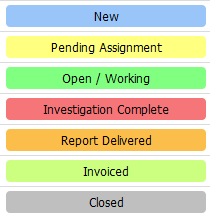
In the above example, we have defined seven example statuses. Lets take a look at what each of these statuses represents:
| New | A newly entered case. The information inside the case still needs to be reviewed for accuracy. |
| Pending Assignment | The case information has been reviewed, and we are now awaiting a manager to assign an investigator. |
| Open / Working | The case is now being worked by the investigator, and new information is being received. |
| Investigation Complete | All investigative work is complete, expenses are submitted, and a draft report has been submitted. |
| Report Delivered | The report and all media has been proofed and delivered to the client. |
| Invoiced | The case has been invoiced, and is awaiting payment. |
| Closed | All loose ends have been tied up (i.e. Case reviews have been answered) |
For a small shop shop, this set of statuses might work really well. You can easily see where each case is, and what needs to be done. However, the more people who work on a case, the more statuses you will likely need in order to make sure everyone is on the same page.
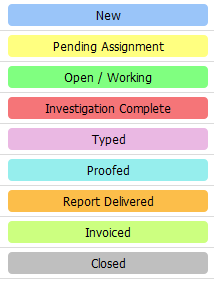
In this example, we've expanded our statuses to add even more control. Let's assume that once the case reaches "Investigation Complete", the investigator submits the draft report to a typist. The typist then dictates the report and sends it to a proofer. The proofer formats and prepares the report and sends it back to the case manager to be "reviewed". Only when the case has been reviewed, can it be delivered to the client. By adding the two statuses "Typed" and "Proofed", we have added more stages that the case must go through to ensure that every step is taken in the case life cycle.
There is really no "wrong" way to do it, and you can always update, remove, or add to your case statuses at any time.
Understanding Case Status Categories
Each case status also belongs to a case status category. Case status categories are transparent to the daily workflow, but provide a couple of important features.
Available case status categories are as follows:
- New - Newly received cases that require review before they are opened.
- Open - Cases that are actively being worked and/or deliverables are still outstanding.
- Complete - All investigative work is complete and delivered, but back office work may be required.
- Closed - The case is closed and no additional work is required.
When a case transitions into status that belongs in new category (i.e. New -> Open), the transition time is logged on the case. This allows for detailed turnaround time reporting using specific reports such as the Case Turnaround Detail report and the Case Turnaround Distribution report.
Preventing Users from viewing the Case Status on Cases
In addition, it is also possible to prevent users in certain user roles from viewing the actual case status on a case, and instead only show them the case status category. To do this, edit the user role, and disable the View status on cases permission. Now, when users associated with this user role access the system, the will only see the case status category instead of the actual case status.
Creating a New Case Status
To create a new case status, click the Settings tab, and then click the Case Statuses link.
Name - The name should be something short and easily recognizable.
Color - The background color that will represent this status. Try to make it visually different than other statuses, and make sure the color reads well behind black text.
Rank Below - The status that this status will follow. Leave this selection blank to make this the "first" case status. The first status is special because all new cases will automatically be assigned to it.
Notes - An explanation of what takes place during this status. This description is only visible in the settings.
Webhook URL (Deprecated) - If populated, Trackops will send a snapshot of your case in JSON format to the specified URL. In order to use utilize webhook URLs, you must have activated your developer API and obtained an API token. The Trackops Zapier integration is a popular use for webhook URLs.
This option is deprecated and its use is discouraged. Instead, use Trackops API Webhooks to send data to third parties, including Zapier.
Monitor Due Date - Indicates that when a case is in this status, some case information (i.e. the report) has not yet been delivered to the client. Things like dashboard widgets and past due filters will only account for cases in statuses that have due date monitoring enabled.
Set as "Active" - An "Active" status indicates that the case is out in the field and new information is still coming in. There are some places in the system where you can filter by only "active" cases. In addition, you can configure your user roles to limit certain types of staff from seeing cases "Non-Active" case statuses.
Set as "Reopenable" - Trackops allows you to reopen a case with a single click, meaning it takes all of the basic case information and creates a new case in the series. This is very useful when you've closed a case and then your client asks you to perform more work down the road. Typically, you will not want to make a status reopenable unless it is beyond the point where all investigative work has been complete. This prevents an accidental reopen, which could cause you to end up with two of the same cases going at once.
Set as "Read-only" - When cases are in a read-only case status, they cannot be edited or changed. In addition, related case data (e.g. Subjects, Case Updates, Reviews, Invoices, etc...) cannot be created or edited.
Workflows - Choose the workflows that this case status should be a part of. Workflows define the the case statuses that make up the the life cycle of a case. Only cases that are associated with one of the selected workflows will be eligible to be moved into this case status.
Reordering Case Statuses
To reorder your case statuses, head over to Settings > Case Statuses, and click Reorder Case Statuses. From here, drag and drop the statuses (in order) into each category to reflect where they best belong. While reordering your statuses, be sure they remain in the correct order (from top to bottom) to reflect your current workflow. Once you've reordered the statuses, click Save Case Status Order and each status will now be in order and in the correct category.
Syncing Transition Timestamps with Current Case Statuses
If you've recently rearranged your case statuses into new case status categories or would like to backfill case status category transition times on old cases, Trackops offers a Sync Cases function. Syncing cases uses the case status history to locate when a case status transitioned into a new case status category and records that timestamp on the case. This can be useful for reviewing reports such as a the Case Turnaround Detail or Case Turnaround Distribution report.
To sync cases with your current case status list, head over to Settings > Case Statuses, and click Sync Cases. Check the box if you want to override existing transition timestamps (by default this option is disabled). Finally, click Continue and the system will process the request.